
The used electric vehicle (EV) market is growing rapidly, and the battery is its most decisive component. For mechanics and resellers, knowing how to assess the real condition of a high-voltage battery is no longer optional; it’s a mark of professionalism and trust.
Thanks to Infocar Power Check Control (PKC), professionals can now diagnose and certify a battery’s health in just a few minutes, with accurate technical data and a clear report to provide to the customer.
But what do indicators like SOH, SOC, or cell imbalance really mean? Here’s a complete breakdown.
1. SOH (State of Health): The Battery’s Core Indicator
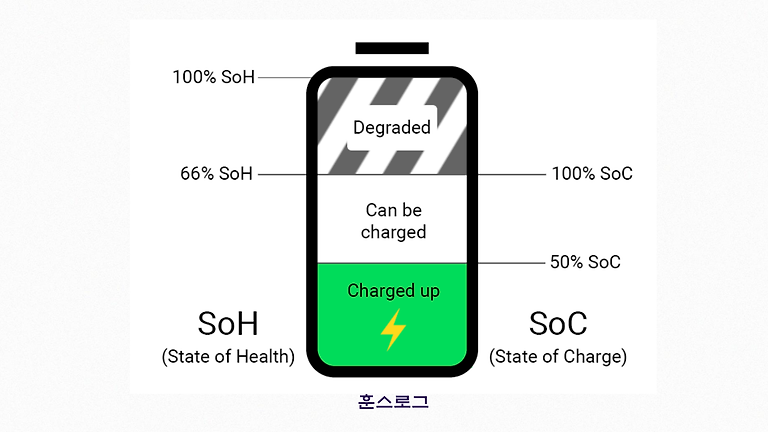
SOH or State of Health measures the actual capacity of a battery compared to its original capacity.
- 100% = brand-new battery
- 80% = still efficient but slightly degraded
- <70% = risk of significant range loss
For a garage, knowing the exact SOH is essential :
- It determines the vehicle’s resale value.
- It helps anticipate failures or loss of range.
- It allows advising the customer on maintenance or trade-in options.
Power Check Control reads this data directly from the BMS (Battery Management System), ensuring a reliable and standardized measurement.
2. SOC (State of Charge): The Instant Charge Level
SOC shows the amount of energy currently available in the battery, as a percentage.
Unlike SOH, it doesn’t indicate health but rather the remaining range at a given moment.
During a PKC diagnostic:
- SOC helps verify consistency between the dashboard display and the actual value.
- It helps understand the test conditions and contextualize the SOH reading.
A reliable test requires a battery that’s neither too full nor too empty (ideally between 20% and 80%).
3. Cell Imbalance: The Early Sign of Degradation
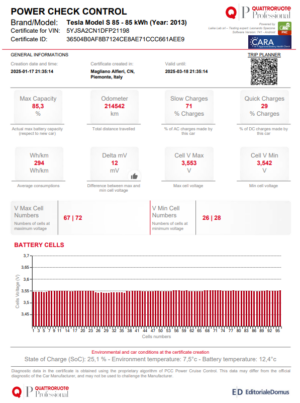
A battery is made up of dozens or even hundreds of cells.
When some discharge or age faster than others, this creates a cell imbalance.
This imbalance can:
- Reduce the overall battery capacity.
- Increase energy consumption.
- Eventually lead to premature failure.
With the detailed PKC report, the mechanic can identify imbalances early, prevent further degradation, and even recommend preventive maintenance.
4. Other Key Data Provided by Power Check Control
Beyond SOH, SOC, and cell balance, the PKC app also provides:
- Number of charge/discharge cycles: an indicator of battery wear.
- Average and maximum temperatures: to detect overheating.
- High-voltage system error codes (DTCs).
- Total and module voltages: for energy stability analysis.
All this information is compiled into a clear, tamper-proof certificate that the garage can print and share with the customer.
5. Benefits for Mechanics and Resellers
- Fast and accurate diagnosis (under 10 minutes).
- Official certificate for greater transparency.
- Service value enhancement, the diagnostic can be billed.
- Customer loyalty through trust and transparency.
Mastering battery diagnostics is now essential for any workshop or reseller dealing with electric vehicles.
With Infocar Power Check Control, you get a reliable, easy-to-use, and highly accurate tool.
Don’t let technology outpace you make battery certification a strategic advantage for your workshop.
Equip your workshop today with Power Check Control.
Order your PKC kit and select your certificate pack to start certifying your EVs now!