
The dual-clutch transmission (DSG/DCT) is a complex component that combines the comfort of an automatic transmission with the efficiency of a manual gearbox. It relies on a mechatronic unit that hydraulically or electronically controls two clutches and the gear selector forks. Clutch wear, mechatronic failure, or even a simple fluid replacement requires precise diagnostics and strict learning procedures (basic settings). A malfunction can lead to jerking, slipping, or even complete vehicle immobilization.
With HaynesPro, technicians gain access to a structured diagnostic methodology, manufacturer wiring diagrams, OEM reference values, and guided procedures to identify faults and perform mandatory calibrations after repairs.
Symptoms of a Faulty or Misadjusted DSG Transmission
The following symptoms are the most commonly encountered in workshops:
- Transmission warning light or flashing PRNDS display:
Common fault codes: P17BF, P189C, P0700, P2711, P177F. - Shuddering during take-off and harsh gear changes :
Loss of clutch bite point calibration (K1/K2) or worn clutch discs. - Loss of even or odd gears :
The mechatronic unit enters protection mode due to a pressure or sensor fault. - Limp mode activation :
The ECU limits engine torque or locks certain gears to protect the transmission. - Excessive clutch slipping :
Advanced mechanical wear or insufficient hydraulic pressure. - Hydraulic fluid leakage :
Pressure loss in the mechatronic accumulator.
Step 1: Data Collection with HaynesPro
HaynesPro provides quick access to:
- Complete mechatronic system wiring diagrams
- OEM reference values:
- Clutch wear tolerances (travel values)
- Nominal hydraulic pressures
- OEM learning strategies and basic settings:
- Preconditions such as temperature and gear lever position for static and dynamic adaptation
- Guided diagnostic procedures
- Precise component locations:
Essential for checking connectors, the mechatronic unit, and drain/fill plugs.
Step 2: Expert DSG / DCT System Diagnosis
Real-Time Data Analysis : Check hydraulic pressures, fluid temperatures, and selector fork positions.
Wear Tolerance Inspection : Compare clutch actuator travel values (K1 and K2) with HaynesPro OEM data to evaluate remaining service life.
Electrical and Hydraulic Verification : Check shaft speed sensor signals and test solenoid valves using wiring diagrams.
Fluid Condition Inspection: Verify oil level and quality (particularly critical on wet-clutch transmissions such as DQ250/DQ381).
Basic Settings and Adaptive Road Test : Strictly follow the manufacturer procedure provided by HaynesPro:
- Reset procedure
- Static calibration with the vehicle stationary
- Specific dynamic driving cycle adaptation
See also our article: Gearbox issues: 3 early warning signs and detection supported by HaynesPro
HaynesPro Case Study: Volkswagen Golf VII 1.4 TSI (DQ200 DSG Transmission)
Symptoms
- Flashing PRNDS display on the dashboard
- Severe shuddering when shifting from 1st to 2nd gear
- Fault code P2711 – Unexpected mechanical disengagement of gear
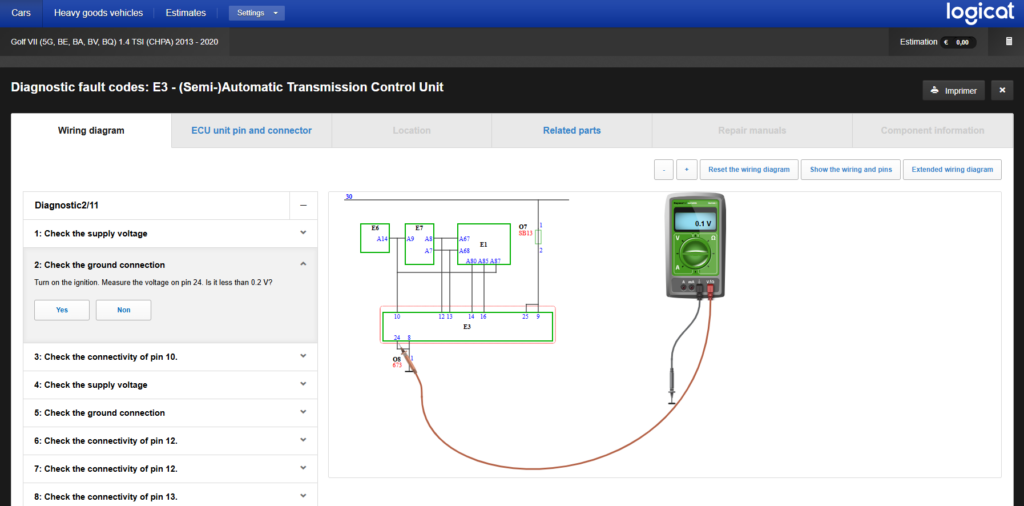
Diagnosis with HaynesPro
- Access to the dry-clutch DSG7 gearbox diagram (DQ200)
- OEM values:
- Checking measuring blocks for clutch lining thickness
- Oil temperature conditions for basic settings: between 30°C and 60°C
Results
- Dual-clutch wear tolerances exceeded
- Functional mechatronic unit (hydraulic pressure OK)
Solution
- Mechanical replacement of the dual-clutch kit
- Execution of the Basic Settings procedure according to the OEM protocol detailed in HaynesPro
- Adaptive road test (Micro-Slip adaptation) successfully completed
Time saved with HaynesPro: approximately 60 minutes (by immediately locating clutch wear tolerance values and the exact relearning procedure conditions).
Possible Solutions Depending on the Diagnosis
- Perform a basic settings procedure (relearning)
- Fluid and filter replacement (for wet-clutch gearboxes)
- Dual-clutch replacement (mechanical kit)
- Mechatronic unit repair or replacement
- Pressure accumulator replacement
- TCM software update if recommended by the manufacturer
Tips for Technicians
- Always connect a battery maintainer (minimum 12.5V) before starting a basic settings procedure.
- Strictly respect the OEM-required oil temperature range for adaptation.
- In HaynesPro, differentiate between procedures for dry-clutch gearboxes (e.g., DQ200) and wet-clutch gearboxes (e.g., DQ250).
- Inform customers that a road adaptation period after the repair is normal to achieve optimal gear shifting.
The dual-clutch transmission is a demanding system that leaves no room for approximation. Thanks to HaynesPro, technicians gain rapid access to manufacturer data, tolerance values, and mandatory basic setting procedures to ensure reliable and long-lasting repairs.
Test HaynesPro and access OEM data for all vehicle types.