
Modern vehicles incorporate numerous electronic systems that need to communicate with each other to ensure the correct operation of comfort, safety and vehicle management functions. While the CAN network is mainly used for high-speed communication between control units, the LIN network (Local Interconnect Network) is generally used for less complex and lower-speed communication between onboard components.
LIN network faults can cause malfunctions in a wide range of onboard equipment, including electric mirrors, power windows, electric seats, climate control systems and various sensors and actuators. With HaynesPro, technicians can access electrical wiring diagrams, component locations, manufacturer procedures and SmartFIX to identify the source of communication faults more efficiently.
The Risks of Misdiagnosis
A LIN communication fault can easily be mistaken for a failure of the affected component. However, several issues may be responsible:
- Open circuit or short circuit on the LIN line;
- Power supply or ground fault;
- Damaged or corroded connector;
- Faulty LIN slave module;
- Faulty LIN master module;
- Communication problem with the control unit;
- Wiring harness fault;
- Software or configuration issue.
Replacing an actuator or module without checking the communication network can therefore result in unnecessary costs and may fail to resolve the original problem.
Essential Checks Before Diagnosis
Before working on a LIN communication fault, technicians should check:
- Fault codes stored in the relevant control units;
- The modules and onboard equipment affected;
- The vehicle communication network;
- Power supplies and ground connections;
- Wiring harness and connector condition;
- LIN line continuity;
- Communication signals, where suitable diagnostic equipment is available;
- Relevant Technical Service Bulletins.
With HaynesPro, technicians can access vehicle-specific technical information to identify the components connected to the network and follow a structured diagnostic procedure.
Workshop Case Study: Electric Seat Malfunction on a BMW 3 Series
Symptom
A BMW 3 Series arrives at the workshop with a fault affecting the driver’s electric seat adjustment. Some adjustment functions no longer operate, while other electrical systems on the vehicle continue to function normally.
Diagnosis
A diagnostic scan identifies a communication problem between the seat control module and a component connected to the LIN network.
Using HaynesPro, the technician accesses:
- Electrical wiring diagrams for the seat adjustment system;
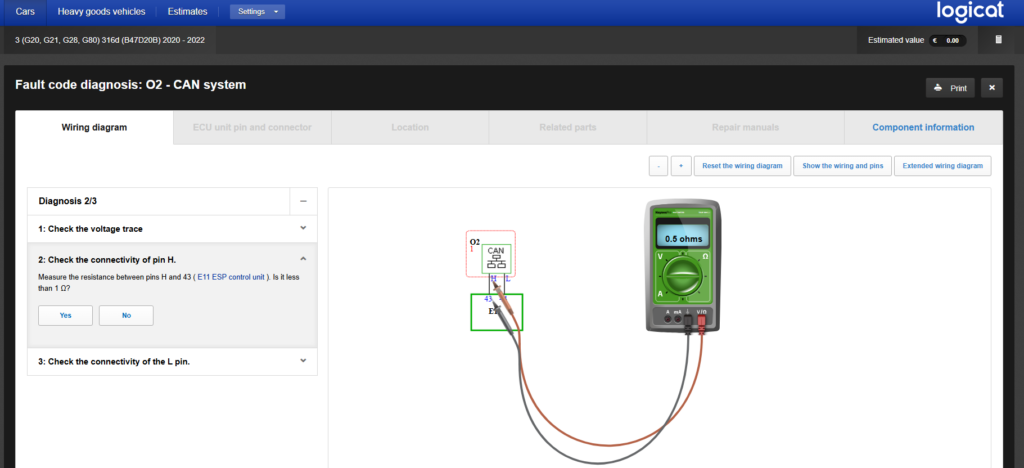
- Locations of the relevant control modules;
- Power supply and ground connections;
- LIN network connections;
- Manufacturer diagnostic procedures;
- SmartFIX to check for known recurring faults.
Testing confirms that the module power supply and ground connections are correct. However, a closer inspection of the wiring harness reveals a partially corroded connector within the seat system.
The poor connection disrupts communication on the LIN network and prevents the affected module from communicating correctly with the master control unit.
Solution
The connector and electrical connections are repaired according to the recommended repair procedure. The system is then tested and the fault codes are cleared.
Result
- LIN communication restored;
- Normal operation of the electric seat adjustment system;
- No unnecessary control module replacement;
- Reduced diagnostic time;
- Vehicle returned with the affected equipment operating correctly.
HaynesPro Features That Simplify LIN Network Diagnostics
For diagnosing onboard communication faults, HaynesPro provides access to:
- Detailed electrical wiring diagrams;
- Control unit and component locations;
- Electrical connection information;
- Manufacturer diagnostic procedures;
- Technical data required for testing;
- Available Technical Service Bulletins;
- SmartFIX, helping technicians identify known faults and repair solutions.
These resources help technicians trace electrical circuits and identify the cause of communication faults more efficiently.
Best Practices for Technicians
When diagnosing a LIN communication fault, technicians should:
- Read all stored fault codes;
- Identify the affected modules and equipment;
- Check power supply and ground connections before replacing any component;
- Consult the vehicle-specific wiring diagrams;
- Inspect the wiring harness and connectors;
- Check LIN line continuity;
- Search for known faults using Technical Service Bulletins or SmartFIX;
- Follow manufacturer diagnostic procedures before replacing a control module.
Why Use HaynesPro for LIN Network Diagnostics?
HaynesPro enables workshops to:
- Quickly access manufacturer electrical wiring diagrams;
- Identify connected control units and onboard equipment;
- Locate components and electrical connections;
- Consult vehicle-specific diagnostic procedures;
- Use SmartFIX to identify known recurring faults;
- Reduce time spent searching for technical information;
- Avoid unnecessary replacement of electronic components.
Communication faults can have multiple causes and produce similar symptoms. Access to accurate, vehicle-specific technical information is therefore essential for following an efficient diagnostic process.
Conclusion
A LIN network communication fault does not automatically mean that an electronic module has failed. The problem may be caused by the wiring harness, a connector, a power supply, a ground connection or another component connected to the network.
A structured diagnostic process allows technicians to check each element before replacing a component. With HaynesPro, automotive repair professionals have access to wiring diagrams, component locations, manufacturer procedures, Technical Service Bulletins and SmartFIX to diagnose LIN communication faults more efficiently.
Discover HaynesPro and access comprehensive technical information for diagnosing vehicle communication network faults and improving workshop efficiency.