
The EVAP system (Evaporative Emission Control System) plays a crucial role in reducing pollutant emissions by preventing fuel vapors from escaping into the atmosphere. A malfunctioning EVAP system can trigger the check-engine light, reduce fuel efficiency, or cause the vehicle to fail an emissions test.
With HaynesPro, mechanics benefit from a clear diagnostic strategy, manufacturer diagrams, and tools to quickly identify micro-leaks, test purge solenoids, and detect the most common faults.
Symptoms of a Faulty EVAP System
Here are the issues technicians encounter most frequently:
- Check-engine light on (MIL / Check Engine): Most common EVAP fault codes include P0440, P0441, P0442, P0455, P0456, P0457…
- Fuel smell around the vehicle: A micro-leak can allow fuel vapors to escape.
- Rough idle or increased fuel consumption: A purge valve stuck open disrupts the air-fuel mixture.
- Refueling difficulty (pump clicking constantly): Canister ventilation lines may be clogged.
- Failed emissions test: An improperly sealed EVAP system causes OBD diagnostics to fail.
Step 1: Data Collection with HaynesPro
HaynesPro provides instant access to:
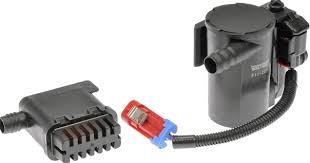
- EVAP circuit diagrams: canister, purge solenoid valve, vent valve, fuel tank pressure sensor.
- Manufacturer strategies and reference values: purge cycles, sensor voltage, activation times.
- Guided test procedures: pressure measurement, solenoid activation, leak testing.
- Precise component locations: essential for checking lines and connections.
Thanks to this information, the mechanic can determine whether the issue is caused by a micro-leak, a faulty sensor, or a stuck solenoid valve.
Step 2: Expert EVAP System Diagnosis
1. Purge solenoid valve test
- Check if the valve is stuck open or closed.
- Measure coil resistance.
- Activate the valve using an OBD-II tool or HaynesPro tests.
2. Inspection of lines and the canister
- Look for cracks or loose connections.
- Check for a clogged filter inside the canister.
3. Micro-leak detection
Use:
- A smoke machine to locate invisible leaks.
- EVAP leak-test procedures from HaynesPro.
4. Fuel Tank Pressure Sensor (FTPS) check
- Compare measured voltage with manufacturer values.
- Observe sensor response during a purge cycle.
5. Canister ventilation test
A faulty vent valve may trigger codes like P0446 or prevent proper purging.
➡ Also check our article on how to diagnose and repair ABS braking system issues: ABS brake system : how HaynesPro helps
HaynesPro Case Study: Renault Clio IV 1.2 TCe (H5F Engine)
Symptoms
- Check-engine light on.
- Fault code P0456 — EVAP system micro-leak.
- No fuel smell, normal engine behavior.
Diagnosis with HaynesPro
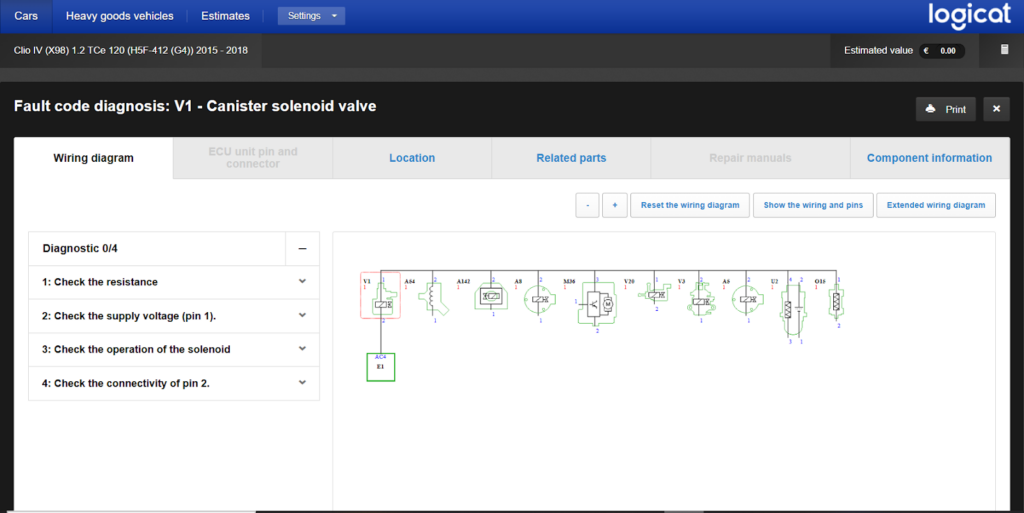
- Access to the EVAP diagram for the H5F engine.
- Guided test: purge solenoid and vent valve activation.
- Manufacturer values:
- Purge solenoid resistance: 22–30 Ω
- FTPS voltage: 0.5–4.5 V depending on pressure
Results
- Purge solenoid OK
- FTPS OK
- EVAP leak test indicates pressure loss
A detailed inspection of the lines using the HaynesPro diagram reveals a micro-crack in the hose between the canister and the fuel tank—impossible to spot without disassembly.
Solution
- Replacement of the EVAP hose
- Clearing fault codes
- Successful purge test
Time saved with HaynesPro: ~45 minutes by avoiding unnecessary tests on the purge solenoid and sensor.
Possible Solutions
- Replacement of the purge solenoid valve
- Replacement of cracked or porous hoses
- Replacement of the FTPS sensor
- Cleaning or replacing a clogged vent valve
- Cleaning or replacing a saturated canister
- Reset of the EVAP monitor after repair
Tips for Mechanics
- Use HaynesPro to identify model-specific weak points (exposed canister, fragile hoses, sensitive sensors).
- Always start with a leak test before replacing expensive components.
- Document each diagnostic step to reassure the customer.
- Check the fuel cap condition: a simple worn-out seal can trigger EVAP codes.
The EVAP system is essential for reducing emissions and ensuring compliance with modern environmental standards. With HaynesPro, mechanics have quick access to OEM data, guided test procedures, and detailed diagrams to efficiently detect micro-leaks and purge-related faults.
Expert diagnostics help reduce workshop time, avoid unnecessary part replacements, and improve customer satisfaction.